3D Starfish SVG: Sculpting Digital Depth from a Timeless Ocean Icon
The starfish has long been a symbol of the ocean's mystery, resilience, and intricate beauty. In digital design, it appears everywhere—from coastal branding to educational marine biology visuals. But the 3D Starfish SVG takes this familiar silhouette into a new realm. By adding depth, shading, and volumetric form, the flat starfish becomes a dimensional object that can be rotated, layered, animated, or printed. This article explores the anatomy, creative applications, and practical considerations surrounding 3D starfish SVGs, offering insights for anyone looking to use or create them.
What Makes a Starfish SVG Feel Three-Dimensional
At its core, an SVG is a vector graphic built from paths, curves, and mathematical points. A standard starfish SVG is typically flat—five arms radiating from a central disk, often with simple fill colors and outlines. A 3D Starfish SVG, however, simulates depth using a combination of techniques that fool the eye into perceiving form and volume.
- Gradient shading: Radial and linear gradients applied to each arm create highlights and shadows, suggesting curvature. A bright spot near the center transitions to darker tones at the edges, mimicking light hitting a rounded surface.
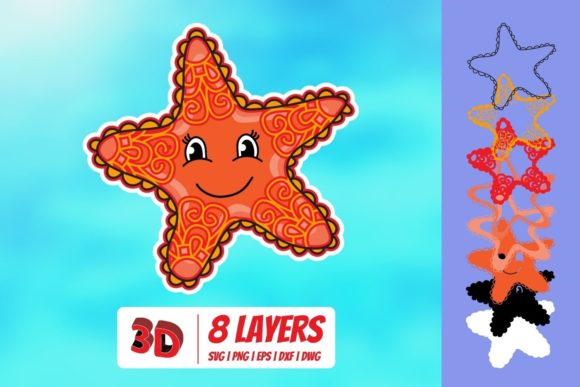
- Overlapping layers: Multiple SVG elements stacked with varying opacity produce the illusion of overlapping plates, spines, or tube feet. This is especially effective for starfish species like the crown-of-thorns or the cushion star, which have textured surfaces.
- Drop shadows and inner glows: SVG filters can add soft shadowing beneath raised areas, making certain parts of the starfish appear to pop forward while others recede.
- Isometric and perspective projection: By distorting the symmetry slightly—making the top arm shorter and the bottom arms longer—the starfish appears tilted in three-dimensional space, as if photographed from an angle.
When these techniques are combined, the result is a graphic that feels tactile and real, even though it remains a lightweight, scalable vector file.
Where Dimensional Starfish Graphics Shine in the Real World
The beauty of a 3D Starfish SVG is that it is not tied to any single industry or purpose. Its versatility makes it valuable across a wide spectrum of use cases.
Branding and Visual Identity
Coastal businesses, aquariums, marine conservation nonprofits, and seafood restaurants often incorporate starfish into their logos. A flat starfish can feel generic or dated. A 3D version adds a sense of modernity, quality, and attention to detail. The dimensional form suggests that the brand is forward-thinking and values craftsmanship. For example, a resort using a subtly shaded 3D starfish in its website header conveys relaxation and depth—literally and figuratively.
Interactive Web and Mobile Experiences
Because SVGs are lightweight and scalable, a 3D Starfish SVG is ideal for interactive elements. Designers can use CSS transforms or JavaScript to rotate the starfish on hover, animate its arms gently waving, or change its color palette based on user interaction. This creates engaging, memorable user experiences without loading heavy image files or relying on canvas-based rendering. Educational apps for children, for instance, can let users tap on different parts of a 3D starfish to learn about its anatomy, with each arm highlighted in turn.
Print and Merchandise Design
Despite being a digital format, SVGs often serve as the source files for print production. A 3D Starfish SVG can be exported to high-resolution PNG or directly used in print layouts for t-shirts, stickers, tote bags, posters, and packaging. The dimensional quality stands out on physical products, especially when printed with metallic inks or spot gloss. A sticker featuring a glossy, shaded starfish will catch the light and draw the eye far more than a flat silhouette.
STEM and Marine Biology Education
Educators and researchers produce diagrams, infographics, and interactive lessons about echinoderms. A 3D Starfish SVG allows students to visualize the radial symmetry and surface textures of real starfish species. By labeling parts directly on the SVG or toggling layers that reveal internal anatomy, teachers can create rich learning materials that are also web-friendly. Unlike photographs, the SVG remains crisp at any zoom level and can be easily modified for different lesson plans.
Digital Art and Creative Projects
Digital artists and hobbyists use 3D starfish SVGs as components in larger compositions—underwater scenes, mandalas, coastal collages, or abstract patterns. Because the SVG retains its vector nature, it can be scaled, recolored, and combined with other graphics without losing quality. A single 3D starfish SVG can become a repeating tile, a central focal point, or a subtle background element depending on the artist's vision.
Key Advantages of Using 3D Starfish SVGs Over Other Formats
When compared to raster images (like JPEG or PNG) or even 3D model files (like OBJ or GLTF), the 3D Starfish SVG occupies a unique sweet spot. Here are its main strengths:
- Infinite scalability: Because it is vector-based, a 3D starfish SVG can be resized from a tiny favicon to a billboard without pixelation. This is critical for responsive web design and multi-format branding.
- Small file size: A well-optimized SVG with gradients and filters is often just a few kilobytes, compared to a high-res PNG that might be hundreds of kilobytes or a 3D model file that could be several megabytes.
- Editability: Anyone with a vector editor like Inkscape, Adobe Illustrator, or even a text editor can tweak the colors, shapes, or depth cues. You can adapt a single design for dark mode, light mode, seasonal variations, or different species.
- Accessibility and SEO: SVGs support embedded text, alt attributes, and semantic structure. A 3D starfish SVG with descriptive tags helps screen readers convey the visual content and can improve search engine ranking for the page.
- Animation potential: CSS animations or JavaScript libraries like GreenSock can bring the 3D effect to life—simulating rotation, pulsing, or swimming motions—all within the browser.
Practical Considerations When Working with 3D Starfish SVGs
While the benefits are clear, there are some nuances to keep in mind. Not every 3D Starfish SVG is created equal, and your specific use case will determine which approach works best.
Complexity vs. Performance
A highly detailed 3D starfish with dozens of overlapping shapes, intricate gradients, and multiple filters can become heavy to render, especially on mobile devices or in low-power browsers. If you are embedding several such graphics on one page, test load times and rendering smoothness. Sometimes a simpler 3D effect—using just two or three gradient layers—achieves a convincing look with better performance.
Color Palette and Context
Starfish in nature range from vivid orange and purple to muted browns and greys. A 3D Starfish SVG can adopt any palette, but the depth effect relies on contrast. A pale starfish on a white background may lose its dimensionality unless shadows are pronounced. Similarly, a dark starfish on a dark background might flatten. Always view your design in the context where it will be used—be that a white website, a dark app, or a printed product.
Licensing and Source Quality
Many free SVG repositories offer starfish graphics, but the 3D quality varies widely. Some files are simply flat SVGs with a gradient slapped on, while others are carefully constructed with proper shading and perspective. If you are using a 3D Starfish SVG for commercial work, verify the license terms. For original creations, start with a clean starfish outline and build the dimensional effects yourself—the control is worth the effort.
Responsive and Adaptive Implementation
When embedding a 3D starfish SVG in a responsive layout, ensure the viewBox and preserveAspectRatio attributes are set correctly. The graphic should scale gracefully without cropping or distortion. If the starfish is part of an interactive component, test touch interactions on tablets and phones, as hover states may not translate directly.
Customizing and Creating Your Own 3D Starfish SVG
Making a 3D Starfish SVG from scratch is entirely possible with basic vector editing skills. The process typically begins with a symmetrical five-pointed star shape, which is then refined to give each arm organic curves and a central disk. From there, depth is added through layering and gradients.
- Start with a base silhouette: Draw the starfish outline using bezier curves. Make the arms slightly irregular—nature rarely produces perfect symmetry, and a bit of organic asymmetry enhances the 3D feel.
- Add a top highlight layer: Duplicate the silhouette, shrink it slightly, and fill it with a radial gradient that is bright at the center and transparent at the edges. This creates a dome-like highlight over the central disk and arm bases.
- Build shadow beneath: Use a drop-shadow filter or a duplicate shape with a dark gradient offset to create the illusion that the starfish sits above the background.
- Texture the surface: For a realistic look, add small circles, bumps, or line segments along the arms to represent spines or tube feet. These can be grouped and styled with their own highlights.
- Test in multiple sizes: View your SVG at 16px, 100px, and 1000px. The 3D effect should hold at all scales. If small details disappear, simplify them; if large areas look flat, add more gradient stops.
For those who prefer ready-made assets, curated marketplaces offer professional 3D Starfish SVG sets that include multiple color variations and arm positions. Some even include animated versions with gentle floating or pulsing motions.
Observing Trends: Why the 3D Starfish SVG Is Gaining Popularity
The broader design trend toward dimensional, organic shapes plays directly into the appeal of 3D starfish SVGs. Flat design, which dominated the 2010s, is now being enriched with subtle depth, textures, and quasi-realistic lighting—sometimes called "flat design 2.0" or "neumorphism." The starfish, with its naturally radial and textured form, is a perfect candidate for this treatment. It offers visual interest without requiring complex 3D modeling software or rendering pipelines.
Moreover, the growing emphasis on ocean conservation and coastal lifestyles has increased demand for marine-themed visuals. Brands want graphics that feel authentic and respectful of nature, not cartoonish or generic. A carefully rendered 3D Starfish SVG communicates that attention to detail and respect for the subject matter. It elevates the visual language from clip art to bespoke design.
Final Thoughts on the Dimensional Starfish in Digital Spaces
The 3D Starfish SVG is more than a passing trend. It represents a convergence of technical capability and artistic intent—a way to bring the ocean's subtle beauty into websites, apps, prints, and educational tools without sacrificing performance or accessibility. For designers, educators, business owners, and hobbyists alike, understanding how to select, create, and implement these dimensional vectors opens up new creative possibilities. Whether you are building a brand identity, teaching marine biology, or designing a personal art project, the 3D starfish offers a rich, scalable, and engaging visual element that resonates across contexts.